

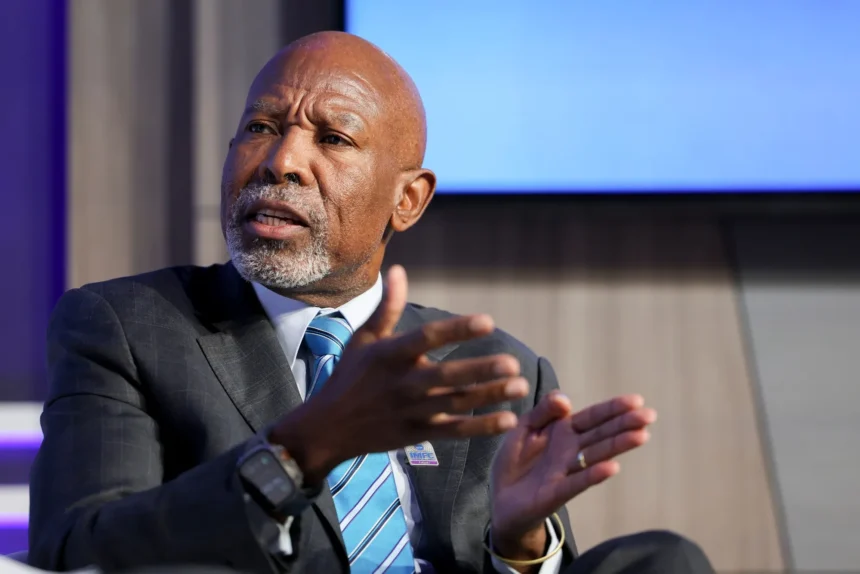
JOHANNESBURG (Elevation News) — South African Reserve Bank Governor Lesetja Kganyago has issued a sharp warning that stablecoins in Africa could undermine national currencies and erode the continent’s monetary sovereignty if governments fail to regulate the growing digital finance market.
In an interview with CNBC Africa, Kganyago said that the spread of US dollar-backed stablecoins such as Tether (USDT) and USD Coin (USDC) is beginning to weaken confidence in local currencies across several African economies. “The creation of stablecoins, especially the dollar-backed ones, is being used to undermine African currencies,” he said. “People are using them to short their currencies, and we are seeing a rise in stablecoin use in countries facing foreign exchange shortages.”
Recent data shows just how fast the shift is happening. Global stablecoin transactions now account for around 30% of all on-chain crypto activity, and in sub-Saharan Africa, that share has climbed to nearly 43% in 2024. In Nigeria alone, transactions involving stablecoins reached about US $22 billion between July 2023 and June 2024. These figures point to a powerful trend: Africans are increasingly turning to digital dollars as a hedge against inflation and currency instability.
According to Standard Chartered, dollar-pegged stablecoins could pull as much as US $1 trillion in deposits from emerging-market banks over the next few years. About 99% of all stablecoins in circulation are tied to the US dollar, making them especially attractive to savers in countries suffering from currency volatility or capital controls. Economists warn that this trend could drain liquidity from domestic banking systems and reduce governments’ ability to manage money supply or control interest rates.
Kganyago said that as more people store and transfer value in digital tokens, “they are almost creating their own foreign exchange markets.” He cautioned that without intervention, some African countries could “lose control of monetary policy altogether.”
The dominance of stablecoins such as Tether (USDT), which commands over 55% of global transaction volume, and USD Coin (USDC), which holds around 23%, has made them the default medium for cross-border trade and remittances in parts of Africa. For citizens in nations like Zimbabwe, Kenya, Egypt, and Ghana, stablecoins have become a practical way to store savings and make international payments, often faster and cheaper than traditional bank transfers.
However, the risks are mounting. The Bank for International Settlements (BIS) recently warned that stablecoins “fail the key tests of sound money” and could threaten financial stability if left unchecked. The report pointed to their lack of consistent oversight and their dependence on US financial systems, which could make developing economies even more vulnerable to global shocks.
Despite the dangers, Kganyago does not advocate an outright ban. Instead, he says countries must strengthen and modernise their currency markets to remain competitive. “We should reform our domestic financial systems rather than prohibit innovation,” he said. In South Africa, stablecoins are classified as financial assets rather than legal tender, allowing regulators to protect consumers while still enabling innovation in the digital economy.
Across the continent, some governments are moving in a similar direction. Kenya has recently passed a law to regulate digital assets, including stablecoins, assigning oversight responsibilities to the central bank. Nigeria and Ghana are developing frameworks for digital currencies of their own, known as central bank digital currencies (CBDCs), in an attempt to provide a regulated alternative to private tokens.
Still, policymakers face a delicate balancing act. Stablecoins offer convenience, lower costs, and access to global finance, crucial benefits in regions where banking systems remain fragile. Yet, their unregulated rise risks undermining sovereign control, draining deposits from local banks, and deepening financial dependence on the US dollar.
For Africa, the challenge is not whether to embrace or reject digital assets, but how to manage them wisely. The continent stands at a crossroads: stablecoins can either empower millions through financial inclusion or destabilise national economies by hollowing out monetary systems.
As Lesetja Kganyago warned, time is running out for regulators to act. Africa’s digital future depends on striking the right balance between innovation and sovereignty, ensuring that financial freedom does not come at the expense of national control.